
For decades, privately held banks dominated local lending, operating outside the constant glare of public markets. Over time, however, a growing share of the U.S. banking system has transitioned to public ownership. While public listings are often viewed as a sign of strength, scale, or access to capital, recent research suggests a more subtle consequence: going public changes how banks take risk.
The Stock Market and Bank Risk-Taking
- Falato, Antonio and Scharfstein, David
- Journal of Finance, 2025
- A version of this paper can be found here
- Want to read our summaries of academic finance papers? Check out our Academic Research Insight category
Key Academic Insights
Public ownership increases bank risk-taking
When banks go public, they increase the risk of both their assets and their funding. Using confidential supervisory CAMELS ratings, the authors show that banks experience a clear deterioration in risk assessments after an IPO compared to similar banks that planned but ultimately canceled their IPOs. The increase is economically meaningful and affects multiple dimensions of risk, not just one balance sheet metric.
Short-term stock market pressure flips the usual logic
In nonfinancial firms, short-termism often leads managers to avoid risky long-term projects. In banking, the opposite holds. The easiest way to boost short-term earnings is to take more risk. Banks can loosen lending standards, reduce loss provisioning, or rely more on short-term funding. These actions raise near-term profits and stock prices while increasing future fragility.
Risk rises in ways markets cannot fully see
A key finding is that not all of the increased risk is observable to investors. Supervisory ratings worsen even after controlling for visible balance sheet changes. This suggests banks take risk through harder-to-detect channels such as underwriting quality, loan loss provisioning, and internal risk controls. This pattern is consistent with managers responding to market pressure by engaging in actions that inflate short-term performance without immediately obvious signals
Short-term gains come with long-term costs
After going public, banks initially report higher profitability, especially return on equity. Over time, this reverses. Earnings decline as risks materialize, provisioning catches up, and asset quality deteriorates. Banks that went public before the financial crisis performed worse during the crisis, particularly those under stronger short-term pressure from shareholders and compensation incentives.
Incentives, not just capital access, drive the behavior
The authors test and largely reject alternative explanations based purely on increased risk-bearing capacity. Even banks that did not raise much equity, did not diversify via acquisitions, and did not see large insider sell-offs still increased risk after going public. The effect is strongest when managers face more short-horizon investors, emphasize short-term metrics in disclosures, or are compensated with short-duration stock options.
Practical Applications for Investment Advisors
Public status is a risk signal, not just a growth signal
Advisors evaluating banks should recognize that public ownership itself can alter incentives. A newly public bank may look stronger on earnings, but that strength can reflect increased risk-taking rather than improved fundamentals.
Look beyond reported performance
Short-term profitability can be misleading in banking. Supervisory-style, forward-looking risk indicators, capital adequacy, underwriting standards, and liquidity buffers are often more informative than recent returns or margins.
Compensation structure matters for resilience
Banks that tie executive pay closely to short-term stock performance tend to increase risk more aggressively. Advisors assessing bank management quality should consider not only how much equity compensation exists, but also how long executives are required to hold it.
Crisis vulnerability is shaped well before the crisis
The paper shows that risk accumulated during normal times explains underperformance during stress. Bank resilience is not built when volatility arrives. It is shaped years earlier through incentives, governance, and ownership structure.
How to Explain This to Clients
“When a bank goes public, it doesn’t just gain access to capital markets. It also starts living quarter to quarter under the stock market’s microscope. In banking, boosting short-term profits often means taking more risk today and dealing with the consequences later. That’s why publicly traded banks can look strong in good times but prove more fragile when conditions turn”
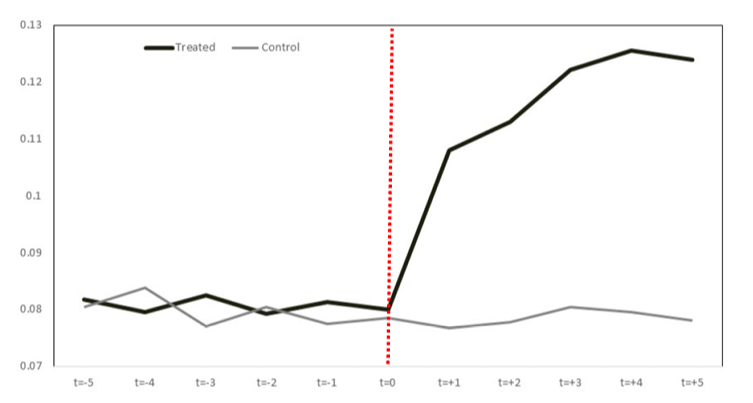
The Most Important Chart from the Paper
Figure 2: Bank Risk Taking Before and After a Private-to-Public Transition: This figure shows the likelihood (average annual frequency) of the Weak CAMELS indicator (vertical axis) in event time leading to and after the year when a bank announces a private-to-public transition (t=0) for treated (the black line) and control banks (the gray line). The results are for the baseline identification sub-sample, the Announced IPOs Sample, which is defined as those commercial banks in our merged BHC-Commercial Bank Sample that over the sample period announce and either complete (“treatment” group) or withdraw (“control” group) a switch from being held by a privately-held BHC to a publicly-traded BHC. The announced switches are due to an IPO, which leads to a sample of 17,754 commercial bank-quarter observations involving 276 unique BHCs and 528 unique commercial banks between 1990 and 2012. Observations to the left (right) of the t=0 line correspond to years before (after) transition announcement.
Abstract
Using confidential supervisory risk ratings, we document that banks increase risk after they go public compared to a control group of banks that filed to go public but withdrew their filings for plausibly exogenous reasons. The increase in risk increases short-term performance at the expense of long-term performance. The increase in risk stems from increased pressure to maximize short-term stock prices and earnings once the bank is publicly-traded. After going public, banks that are owned by investors that place greater value on short-term performance increase risk more, and those managed by CEOs with more short-term compensation also increase risk more.
About the Author: Elisabetta Basilico, PhD, CFA

—
Important Disclosures
For informational and educational purposes only and should not be construed as specific investment, accounting, legal, or tax advice. Certain information is deemed to be reliable, but its accuracy and completeness cannot be guaranteed. Third party information may become outdated or otherwise superseded without notice. Neither the Securities and Exchange Commission (SEC) nor any other federal or state agency has approved, determined the accuracy, or confirmed the adequacy of this article.
The views and opinions expressed herein are those of the author and do not necessarily reflect the views of Alpha Architect, its affiliates or its employees. Our full disclosures are available here. Definitions of common statistics used in our analysis are available here (towards the bottom).
Join thousands of other readers and subscribe to our blog.