
The phenomenon of “reaching for yield”—investors shifting towards riskier assets when interest rates are low—has been well-documented among institutional investors. However, this article provides direct evidence that individual households exhibit similar behavior. Analyzing transaction data from a large brokerage firm, the study finds that younger and less-wealthy individuals are more prone to increasing their exposure to riskier assets in low-interest environments. Additionally, investors experiencing losses are more likely to seek higher yields, aligning with prospect theory. These insights have significant implications for financial advisors and policymakers aiming to understand and guide household investment behavior
Reaching for yield: Evidence from households
- Francisco Gomes , Cameron Peng , Oksana Smirnova , Ning Zhu
- The Journal of Financial Economics, June 2025
- A version of this paper can be found here
- Want to read our summaries of academic finance papers? Check out our Academic Research Insight category
Key Academic Insights
Households Reach for Yield in Low-Interest Environments: The study provides field evidence that individual investors, like institutions, tend to shift towards riskier assets when interest rates decline.
Demographic Variations in Behavior: Younger and less-wealthy individuals are more likely to engage in yield-seeking behavior, possibly due to longer investment horizons and the need to build wealth.
Influence of Losses on Risk-Taking: Consistent with prospect theory, investors experiencing losses are more inclined to pursue higher yields, potentially to recover previous losses, a pattern also echoed in Alpha Architect’s post on yield-seeking dividend investors, which explores the behavioral biases driving this search.”
Reverse Reaching for Yield: Interestingly, the study also identifies instances where certain investor subgroups reduce risk exposure in response to low interest rates, a behavior termed “reverse reaching for yield.”
Practical Applications for Investment Advisors
Educate Clients on Risk-Return Trade-offs: Advisors should help clients understand the implications of increasing risk exposure in pursuit of higher yields, especially in low-interest environments as discussed in Alpha Architect’s bond strategy piece on reaching for safety.
Tailor Strategies to Client Profiles: Recognize that younger and less-wealthy clients may be more susceptible to yield-seeking behavior, necessitating personalized guidance to align investment choices with long-term goals.
Monitor Behavioral Biases: Be vigilant of clients who have experienced recent losses, as they may be more prone to making riskier investment decisions in an attempt to recoup losses.
How to Explain This to Clients
“When interest rates are low, it’s natural to look for investments that offer higher returns. However, it’s important to understand that higher returns often come with higher risks. Our goal is to build a diversified portfolio that aligns with your financial objectives and risk tolerance, rather than chasing yields that may not be sustainable or appropriate for your situation.”
The Most Important Chart from the Paper
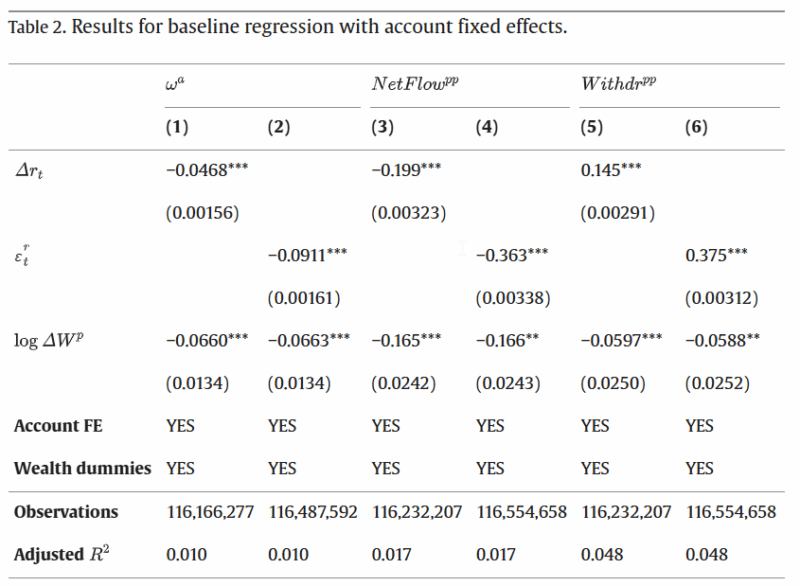
The table below shows shows that, on average, retail investors reach for yield. This conclusion is reached under all three measures of rebalancing behavior that we consider, and for both measures of interest rate innovation.
The results are hypothetical results and are NOT an indicator of future results and do NOT represent returns that any investor actually attained. Indexes are unmanaged and do not reflect management or trading fees, and one cannot invest directly in an index.
Abstract
The literature has documented “reaching for yield”—the phenomenon of investing more in risky assets when interest rates drop—among institutional investors. We analyze detailed transaction data from a large brokerage firm to provide direct field evidence that individual investors also exhibit this behavior. Consistent with models of portfolio choice with labor income, reaching for yield is more pronounced among younger and less-wealthy individuals. Consistent with prospect theory, reaching for yield is more pronounced when investors are trading at a loss. Finally, we observe and discuss the phenomenon of “reverse reaching for yield.”
About the Author: Elisabetta Basilico, PhD, CFA

—
Important Disclosures
For informational and educational purposes only and should not be construed as specific investment, accounting, legal, or tax advice. Certain information is deemed to be reliable, but its accuracy and completeness cannot be guaranteed. Third party information may become outdated or otherwise superseded without notice. Neither the Securities and Exchange Commission (SEC) nor any other federal or state agency has approved, determined the accuracy, or confirmed the adequacy of this article.
The views and opinions expressed herein are those of the author and do not necessarily reflect the views of Alpha Architect, its affiliates or its employees. Our full disclosures are available here. Definitions of common statistics used in our analysis are available here (towards the bottom).
Join thousands of other readers and subscribe to our blog.