
This paper reveals a hidden burden in the U.S. regulatory system: multiple federal agencies often regulate the same issue, creating what the authors call “regulatory fragmentation.” Using advanced textual analysis of the Federal Register, the study shows that fragmentation, especially when agencies don’t coordinate, leads to higher costs, lower productivity, reduced growth, and fewer market entrants. Rather than streamlining oversight, overlapping mandates between agencies create confusion, redundancy, and sometimes outright inconsistency. The result? A drag on firm performance and broader economic efficiency.
Regulatory Fragmentation
- Joseph Kalmenovitz, Michelle Lowry, and Ekaterina Volkova
- The Journal of Finance, 2025
- A version of this paper can be found here
- Want to read our summaries of academic finance papers? Check out our Academic Research Insight category
Key Academic Insights
Fragmentation Adds Overhead, Slows Growth
When multiple regulators govern the same topic, it’s not just redundancy—it’s confusion. Firms face more SG&A expenses, lower return on assets, and decreased total factor productivity. In fragmented regulatory environments, companies expend more effort managing compliance and less on innovation or expansion.
Coordination Matters
The study finds that when multiple agencies collaborate on rulemaking, the negative effects of fragmentation are significantly reduced. But when agencies act independently, firms are left navigating conflicting mandates – leading to worse performance outcomes.
The Regulatory Map Isn’t Flat
Using machine learning on the Federal Register, the authors map 100 regulatory topics and track which agencies are involved. Some industries, especially finance, show heavy topic concentration but high fragmentation, or many agencies involved in a narrow set of topics. In contrast, industries like healthcare spread across more topics, but face less overlapping agency oversight.
Capture Gets Harder, Not Easier
Fragmentation also undermines firms’ ability to influence policy. Lobbying falls in more fragmented contexts, suggesting that companies struggle to know which agency to target. That might be good for regulatory independence, but it increases compliance uncertainty.
Practical Applications for Investment Advisors
Regulatory Risk Isn’t Just Rules. It’s Structure
Advisors helping firms navigate compliance should pay attention to not just the volume of regulation, but how many agencies are involved. A concentrated topic governed by many agencies (e.g., banking) poses more friction than a dispersed one regulated by a single body.
Complexity Hurts the Little Guys
Smaller firms are disproportionately affected. The study finds fragmentation deters entry and accelerates small firm exits, altering industry dynamics. Advisors working with startups or small-cap clients should factor in regulatory fragmentation when assessing market viability.
ESG and Fragmentation May Collide
As ESG oversight grows, many agencies (SEC, EPA, DOL) may pile on, potentially creating a fragmented web. This research implies that ESG mandates could be particularly costly if not coordinated.
How to Explain This to Clients
“Imagine trying to comply with three different sets of rules from three bosses on the same issue—each with their own language and deadlines. That’s what regulatory fragmentation is like. It’s not just red tape—it’s multiple overlapping tapes that make it hard to move forward. This complexity impacts your investments, especially in industries like banking or energy.”
The Most Important Chart from the Paper
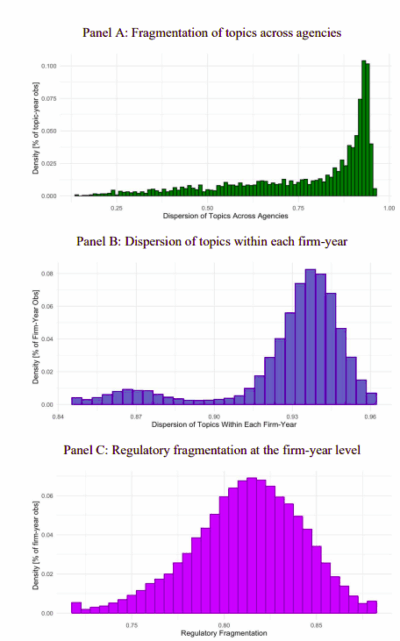
This histogram shows the distribution of firms’ exposure to regulatory fragmentation. Unlike the fragmentation of individual topics (Panel A) or the dispersion of topics within a firm (Panel B), the firm-level exposure is more normally distributed—indicating that fragmentation affects nearly every firm, but to varying degrees. This data-driven measure blends the number of agencies involved per topic with each firm’s exposure to those topics via their 10-K filings.
The results are hypothetical results and are NOT an indicator of future results and do NOT represent returns that any investor actually attained. Indexes are unmanaged and do not reflect management or trading fees, and one cannot invest directly in an index.
Abstract
Regulatory fragmentation occurs when multiple federal agencies oversee a single issue. Using the full text of the Federal Register, the government’s official daily publication, we provide the first systematic evidence on the extent and costs of regulatory fragmentation. Fragmentation increases the firm’s costs while lowering its productivity, profitability, and growth. Moreover, it deters entry into an industry and increases the propensity of small firms to exit. These effects arise from redundancy and, more prominently, from inconsistencies between government agencies. Our results uncover a new source of regulatory burden, and we show that agency costs among regulators contribute to this burden.
About the Author: Elisabetta Basilico, PhD, CFA

—
Important Disclosures
For informational and educational purposes only and should not be construed as specific investment, accounting, legal, or tax advice. Certain information is deemed to be reliable, but its accuracy and completeness cannot be guaranteed. Third party information may become outdated or otherwise superseded without notice. Neither the Securities and Exchange Commission (SEC) nor any other federal or state agency has approved, determined the accuracy, or confirmed the adequacy of this article.
The views and opinions expressed herein are those of the author and do not necessarily reflect the views of Alpha Architect, its affiliates or its employees. Our full disclosures are available here. Definitions of common statistics used in our analysis are available here (towards the bottom).
Join thousands of other readers and subscribe to our blog.