
We often assume that simplifying investment products helps reduce risk. But this paper challenges that intuition. Puri shows that simpler structures—like low-dimensional lotteries or intuitive cash flows—can actually encourage investors to take on more risk. Why? Because people misunderstand the risk in simple designs and overestimate their returns. Using detailed experiments with lottery-like payoffs and real investment choices, the paper finds that perceived simplicity can distort demand and lead to inefficient pricing. For advisors, the message is clear: simplifying products might not reduce client risk—it could increase it if not paired with proper education and expectations management.
Simplicity and Risk
- INDIRA PURI
- Journal of Finance, 2025
- A version of this paper can be found here
- Want to read our summaries of academic finance papers? Check out our Academic Research Insight category
Key Academic Insights
Simplicity Can Be Misleading
Investors often interpret simpler assets as safer, even when the underlying risk is unchanged. This can lead to a mismatch between perceived and actual risk.
Demand Increases with Simplicity
Experimental results show that when complex financial products are simplified in presentation (e.g., using visual aids or fewer outcomes), investor demand increases—even for high-risk assets.
Overvaluation of Risky Simplicity
Investors are willing to pay more for risky assets when those risks are framed simply. This leads to price distortions in markets and potentially inefficient allocations of capital.
Behavioral Biases Drive This Effect
The paper links these findings to behavioral tendencies like overconfidence and narrow framing. Simplicity reduces cognitive load but masks the true risk-reward profile.
Practical Applications for Investment Advisors
Don’t Confuse Simplicity with Safety
A well-designed ETF or structured product may appear “cleaner” to a client but still carry substantial risk. Advisors must carefully walk clients through the real risk exposures.
Use Simplicity Strategically—Not Superficially
Simplifying the presentation of portfolios or models is helpful, but it must come with clear risk disclosure. Otherwise, clients may assume the strategy is less volatile than it actually is.
Watch for Mispriced Risk in Client Behavior
If clients gravitate toward a specific investment because “it looks straightforward,” take a closer look. They may be unintentionally overexposing themselves to tail risk or complexity hiding under a simple façade. This behavior is similar to another blog, which discusses how trust in a financial advisor can lead investors to take on more risk than intended.
How to Explain This to Clients
“Sometimes, simple-looking investments can actually be more risky than they seem. Just because something is easy to understand doesn’t mean it’s safer. Our job is to help you see the full picture, so we’re not just choosing the simplest path—we’re choosing the smartest one.”
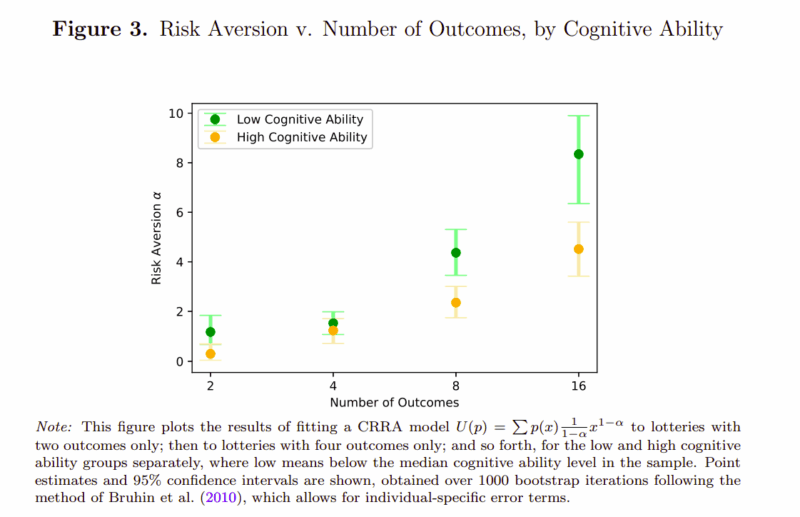
The Most Important Chart from the Paper
Figure 3 splits participants in the risk aversion module by cognitive ability – above or below median, respectively – and plots risk aversion by number of outcomes. The result at two outcomes replicates that of the above literature, e.g. low cognitive ability individuals have higher measured ‘risk aversion.’ However, as complexity increases to eight and sixteen outcomes, the discrepancy in CRRA-measured risk aversion further diverges, indicating that complexity aversion and measured cognitive ability are weakly negatively correlated.
The results are hypothetical results and are NOT an indicator of future results and do NOT represent returns that any investor actually attained. Indexes are unmanaged and do not reflect management or trading fees, and one cannot invest directly in an index.
Abstract
I introduce and test for preference for simplicity in choice under risk. I characterize the theory axiomatically, and derive its properties and unique predictions relative to canonical models. By designing and running theoretically motivated experiments, I document that people value simplicity in ways not fully captured by existing models that study risk premia in financial markets. Participants’ risk premia increase as complexity increases, holding moments fixed; their dominance violations increase in complexity; their behavior is predicted by simplicity’s characterizing axiom; and their complexity aversion is heterogeneous in cognitive ability. None of expected utility theory, cumulative prospect theory, prospect theory, rational inattention, sparsity, salience, or probability weighting that differs by number of outcomes fully capture the experimental findings. I generalize the underlying theory to additionally capture broader measures of complexity, including obfuscation, computation, and language effects.
About the Author: Elisabetta Basilico, PhD, CFA

—
Important Disclosures
For informational and educational purposes only and should not be construed as specific investment, accounting, legal, or tax advice. Certain information is deemed to be reliable, but its accuracy and completeness cannot be guaranteed. Third party information may become outdated or otherwise superseded without notice. Neither the Securities and Exchange Commission (SEC) nor any other federal or state agency has approved, determined the accuracy, or confirmed the adequacy of this article.
The views and opinions expressed herein are those of the author and do not necessarily reflect the views of Alpha Architect, its affiliates or its employees. Our full disclosures are available here. Definitions of common statistics used in our analysis are available here (towards the bottom).
Join thousands of other readers and subscribe to our blog.