
Student debt is often treated as a personal issue. Individuals borrow, replay, and manage their own financial outcomes. But in reality, debt burdens shape much more than individual balance sheets. They affect credit markets, labor mobility, and long-term economic opportunities. This paper introduces a new perspective. Debt relief is not just redistribution. It changes behavior, incentives, and financial stability. The result is a powerful mechanism. Reducing debt burdens improves both financial and labor market outcomes and targeted relief can reshape economic trajectories for distressed borrowers.
Second Chance: Life with Less Student Debt
- Marco Di Maggio, Ankit Kalda, Vincent Yao
- The Journal of Finance, 2026
- A version of this paper can be found here
- Want to read our summaries of academic finance papers? Check out our Academic Research Insight category
Key Academic Insights
Debt relief improves overall financial health
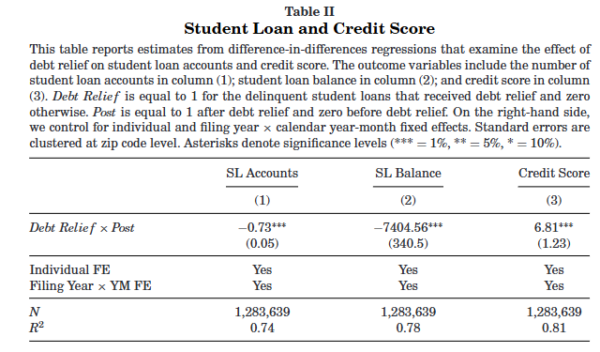
The paper shows that borrowers who receive student debt discharge reduce their total liabilities and improve credit outcomes. Rather than increasing borrowing, they deleverage. Lower balances, reduced utilization, and higher repayment rates all point to improved financial discipline following relief.
Spillover effects extend beyond student loans
Debt relief does not operate in isolation. Borrowers who receive relief experience significantly lower delinquency rates across other forms of debt, including credit cards and mortgages. This highlights positive externalities, where improving one part of the balance sheet strengthens the entire financial position.
The costs of default matter as much as the relief
A key insight is that both treated and control groups drive the results. While treated borrowers benefit from discharge, control borrowers face wage garnishment and collections. These enforcement mechanisms tighten liquidity constraints and worsen outcomes, amplifying the relative gains from relief.
Debt overhang distorts economic decisions
When borrowers expect future income to be seized through garnishment, incentives to work, move, or pursue better opportunities decline. Removing debt alleviates this distortion, restoring incentives for income growth and long-term decision-making.
Mobility increases after debt discharge
Borrowers who receive relief are more likely to change residence, switch jobs, and move across industries. This suggests that debt acts as a constraint on geographic and professional mobility, limiting access to better opportunities.
Income rises following debt relief
Treated borrowers experience higher income growth and earn approximately $3,000 more over three years. This reflects both improved labor incentives and increased productivity following relief from financial distress.
Psychological effects play a meaningful role
Financial distress reduces cognitive function and productivity. Debt relief alleviates stress, leading to improved work performance. This is reflected in higher variable pay, such as bonuses and overtime, and increased labor supply.
Practical Applications for Investment Advisors
Debt burdens affect more than consumption
Student debt influences not only spending but also borrowing behavior, credit performance, and labor market outcomes. Advisors should consider debt as a key driver of long-term financial trajectories.
Recognize spillover effects across balance sheets
Reducing one liability can improve overall financial stability. Lower delinquency and reduced leverage suggest that debt relief can strengthen household balance sheets more broadly.
Incorporate labor income dynamics
Debt overhang and financial distress can affect income growth and career decisions. Portfolio construction should account for the interaction between human capital and financial constraints.
Understand heterogeneity in outcomes
The benefits of debt relief are strongest for distressed and liquidity-constrained borrowers. Targeting matters. Blanket conclusions may overlook these differences.
How to Explain This to Clients
“Student debt doesn’t just affect what people owe. It affects how they live and work. When debt becomes too burdensome, it can limit job opportunities, reduce income growth, and increase financial stress. When that burden is reduced, people tend to improve their financial situation. They pay down other debts, become less likely to miss payments, and are more able to pursue better job opportunities. The benefit goes beyond the loan itself and improves overall financial stability.”
The Most Important Chart from the Paper
The results are hypothetical results and are NOT an indicator of future results and do NOT represent returns that any investor actually attained. Indexes are unmanaged and do not reflect management or trading fees, and one cannot invest directly in an index.
Abstract
We exploit an episode of plausibly random debt discharge due to the loss of paperwork for thousands of defaulted borrowers to examine the effects of private student debt relief on borrower outcomes. We find that borrowers who receive debt relief (treated) experience declines in debt balances and delinquency rates on other accounts, and increases in mobility and income relative to those who bear the costs of default like wage garnishment and collections (control). Borrowers in both groups contribute to our findings through different mechanisms. While our estimates may not directly apply to blanket student loan forgiveness, they speak to the benefits of forgiveness in reducing the consequences of debt burden for distressed borrowers.
About the Author: Elisabetta Basilico, PhD, CFA

—
Important Disclosures
For informational and educational purposes only and should not be construed as specific investment, accounting, legal, or tax advice. Certain information is deemed to be reliable, but its accuracy and completeness cannot be guaranteed. Third party information may become outdated or otherwise superseded without notice. Neither the Securities and Exchange Commission (SEC) nor any other federal or state agency has approved, determined the accuracy, or confirmed the adequacy of this article.
The views and opinions expressed herein are those of the author and do not necessarily reflect the views of Alpha Architect, its affiliates or its employees. Our full disclosures are available here. Definitions of common statistics used in our analysis are available here (towards the bottom).
Join thousands of other readers and subscribe to our blog.